- The Wealthy Prognosis
- Posts
- Calculated Convergence
Calculated Convergence
Combining our lives effectively and efficiently.

Howard & Peter
September 28, 2025
OUR ADDICTION TO SYNERGY

For all the Notion enthusiasts, this callow noob is finally coming to understand the hype. It has been months since Peter’s first attempts to convert me. Much to his eagerness, my life is now organized and more streamlined with his.

Though I was initially hesitant, the fold into Notion was but another step toward integrating our lives more seamlessly. The app’s interface easily allows for Peter to see what projects I am working on, and vice versa. It allows for us to organize our busy lives and find ways to support the other more intuitively. Organization has always been a skill of Peter’s, and confers two huge benefits: ease of tracking and freeing up resource for development in other areas.

Though Notion is the latest development, our organizational systems have evolved continuously over the course of our relationship. It started first with the sharing of Google calendars so we could plan more dates. The sharing of calendars quickly progressed to designing and combining schedules into our “ideal week.” This became easier and felt more natural with our eventual cohabitation.

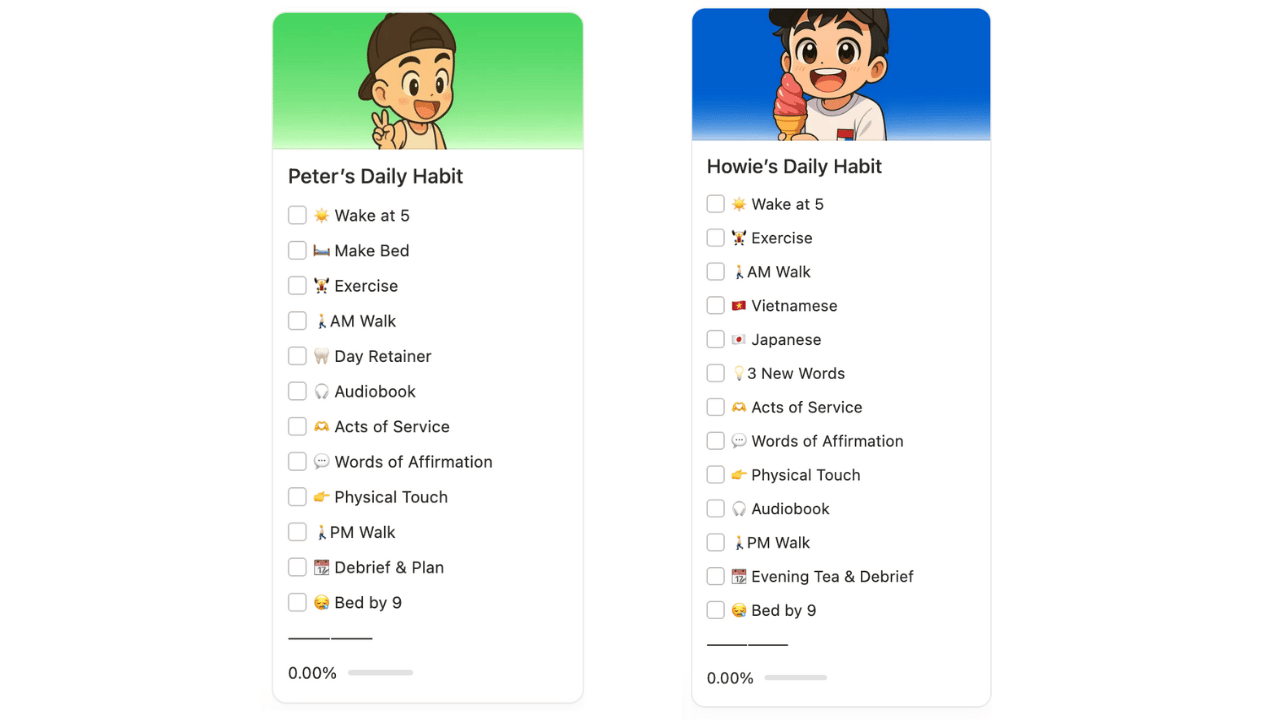
We actually still use Google calendar to a great extent: primarily as a tool for planned events. But in addition, we also utilize two physical calendars to keep track of all the people we need or want to see in the coming month. The physical calendars serve as blatant reminders when we forget to scroll forward to the coming months. Excel continues to be our go-to for tracking our fitness goals—nothing beats a simple grid for tracking workouts. But when it comes to daily habits, tasks, and achievements, Notion has been a great tool for tracking progress.

With its functionalities, we could have easily incorporated every aforementioned element into Notion. However, we keep Notion as primarily a project manager. This is simply because the other tools edge it out slightly in effectiveness for their respective and niche purposes. The biggest draw to Notion for me is the ability to track my growth in habit formation. Our relationship has seen first hand the benefits of keeping a steady habit.
In the first few months of dating, especially as we transitioned into living together, Peter and I divvied up each weekend to address major concerns. The first weekend of the month would be dedicated to reviewing finances together: a review of our monthly expenditures. The second weekend would be dedicated to doing an apartment and life inventory, making sure that our home is adequately stocked. The third weekend would be dedicated to an exercise we call RADAR, essentially our way to systematically reflect on different domains of the relationship. The final weekend(s) of the month would be dedicated to personal hobbies and/or other fun activities.

Over time, these tasks became easier both through our tracking methods but also with practice. We’re now at a phase where tasks which previously required a dedicated weekend are now all condensed into one weekend. This has freed up more time for our personal endeavors. Because of this, I am now eager to use Notion to continually refine my own daily and individual habits. Though Peter has always been more disciplined, he finds it really fun to keep track of our daily habits together and to work as accountability buddies.

Due to freed up resources of time and energy, we were able to embark on a new habit together: listening to audiobooks. The first book we enjoyed together was Atomic Habits by James Clear, which I highly recommend to anyone seeking an easy but influential read. It incorporates a lot of our own philosophies and delves into the behavioral components of habituation (naturally piqued my interest)! It was the perfect timing as we create new systems that help our habits flourish.

Time and energy consistently are our scarcest resources. Peter is not so easily satisfied with constancy and stagnation, so he is always finding ways to claw back resources to invest elsewhere. That is, as he “masters” certain areas or skills in his life, he finds ways to automate, streamline, or eliminate the process. This way, he continues to have the resource to challenge himself. Growth is most easily conceptualized linearly for Peter.
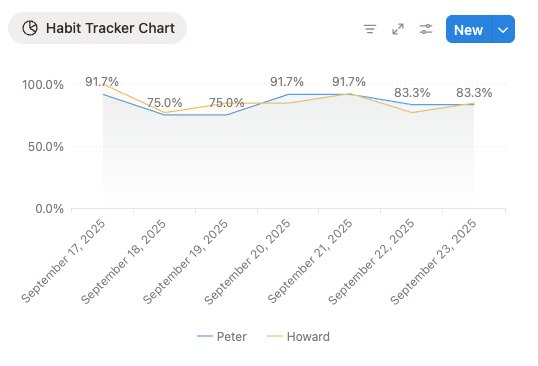
I, on the other hand, am happy with increased structure in my life. I am not particularly disorganized, but am certainly more free-flowing than Peter. Though there was some initial resistance in adopting his methods, I am slowly coming around to this madness. It’s actually been easy and refreshing to move forward with the programming with virtually no downside. Perhaps my initial hesitance was simply the fear of change itself—something that I don’t often like to admit.

XOXO,
Howard and Peter